
Why higher US Treasury yields may be more opportunity than alarm

Brendan Murphy
Head of Fixed Income, North America
Not investment advice. Please refer to the risk disclosures at the bottom of the page

1
US Treasury yields have risen sharply, driven largely by heavy government borrowing and changing demand from investors.
2
Higher yields do not automatically mean markets expect a US debt crisis; so far, other warning signs remain relatively muted.
3
For active investors, the shift may create openings in parts of the bond market where prices now better reflect risk and reward.
US government bonds are not usually the stuff of dramatic headlines, yet recently they have moved to centre stage.
That is because long-term Treasury yields have climbed to levels not seen for years. When that happens, it tends to unsettle markets far beyond the bond world. Higher Treasury yields affect mortgage costs, company borrowing, pension funding and the value of other assets around the world.
The obvious question is whether investors should see this as a warning sign – rising yields can sound ominous, especially when they come alongside headlines about soaring US debt. But the story looks more complex than that. In fact, the move may say more about supply and pricing than panic.
The market is being asked to absorb more debt, with less official support and more competition from elsewhere.
Source: Insight and Bloomberg, 1 September 2026. Yield is a bond’s expected annual return until it matures, expressed as a percentage of its price. It accounts for regular income and capital repayment at maturity, assuming payments are reinvested at the same rate and the issuer does not default. Years to maturity measures the number of years until a bond is due to repay the full amount borrowed by the issuer.
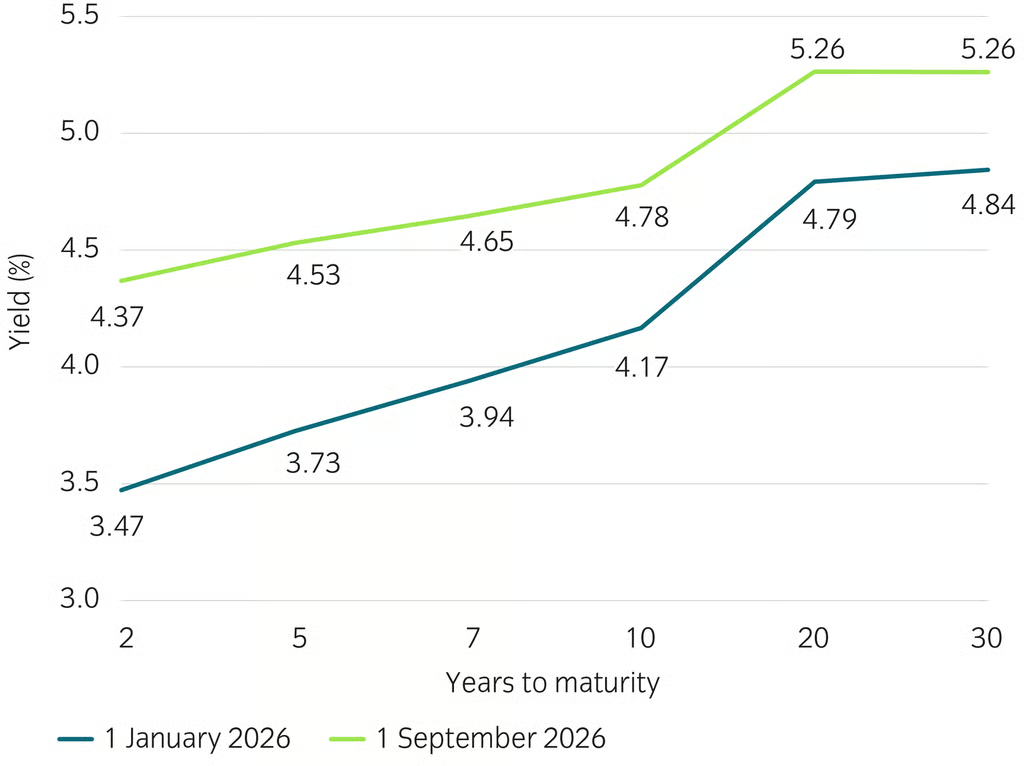
US Treasury yields have risen significantly this year
The first reason is simple: the US government is borrowing a lot of money.
Federal debt has reached striking levels, and budget deficits are expected to stay large. That means the Treasury must keep issuing new bonds to fund spending. When more bonds come to market, investors often demand a higher yield to absorb that extra supply.
In plain English, the government is asking buyers to take on more debt, so buyers want a better return.
There is a second change too. In the past, the US Federal Reserve bought large amounts of government bonds. That helped support prices and keep yields lower. Today, that support is much smaller. Private investors now have to take up more of the slack, and they tend to be more price-sensitive than a central bank.
Global competition also matters. Investors do not look at US bonds in isolation. Yields have risen in other major markets, including Europe and Japan. As bonds elsewhere start to offer more appealing returns, some investors may have less interest in holding as many Treasuries.
There is another twist. Some large US companies have recently issued long-dated debt at yields that look attractive compared with government bonds. For investors willing to take a little more risk, those bonds can look like serious alternatives.
Put all that together, and higher Treasury yields start to look less mysterious. The market is being asked to absorb more debt, with less official support and more competition from elsewhere.
Why yields are rising

That still leaves the big worry: could higher yields mean investors are losing faith in the US?
So far, the evidence suggests caution rather than crisis.
If markets were truly starting to doubt the US government’s ability to repay its debts, we would expect to see stress in several places at once. Borrowing costs would jump. Demand at Treasury auctions would weaken badly. Foreign investors might pull back sharply. The dollar could also come under more obvious pressure.
That is not what has happened.
Instead, markets appear to be functioning in a fairly orderly way. Investors are asking for more compensation, but not behaving as though default is around the corner. A country can have an uncomfortable fiscal outlook without being close to a funding crisis.
This does not mean deficits are harmless. Large, persistent borrowing needs can keep long-term yields under pressure for years; they can also leave the government more exposed to changes in interest rates. But that is different from saying the market believes the system is about to break.
In other words, rising yields may reflect a repricing, not a panic.
Why this may not signal a crisis
When markets adjust quickly for technical reasons such as supply and demand, pricing can become more interesting.
For active investors, the opportunity may not lie exactly where the headlines point. Much of the attention has focused on 30-year Treasuries because that part of the market has seen some of the sharpest moves. But the long end of the bond market also carries more uncertainty. Inflation, fiscal policy and long-term investor demand all matter more there. That may make shorter- and medium-dated bonds more appealing in the near term.
These maturities tend to respond more directly to changes in expectations for interest rates and central bank policy. If inflation continues to cool, or if the Federal Reserve signals a softer stance, those parts of the market could benefit sooner. They may also offer investors a more balanced trade-off between income and risk.
Longer-dated bonds could become attractive too, especially if yields rise further and start to draw buyers back in. But that may require patience. Investors need to be paid enough to take on the extra uncertainty that comes with lending for 20 or 30 years.
More broadly, the recent move is a reminder that bond markets are once again offering real income. For years, yields were so low that fixed income often felt unrewarding. That is no longer true. Investors can now be more selective and ask tougher questions about value across government and corporate debt.
Where active investors may find opportunities
So far, the evidence suggests caution rather than crisis.
Rising Treasury yields deserve attention because they shape borrowing costs and investment decisions across the global economy, but they should not automatically be read as a sign of crisis.
Much of the recent move appears to reflect heavy supply, less support from the Federal Reserve and changing competition for investor money. That may keep pressure on yields, but it is not the same as a collapse in confidence.
For investors, higher yields can bring discomfort, but they can also restore value. In a market that has repriced sharply, active investors may find that today’s tension is also creating tomorrow’s opportunities.
Higher yields may be a reset, not a red flag
Brendan Murphy is Head of Fixed Income, North America at Insight Investment.
He is responsible for overseeing the implementation of all US fixed income investment processes at Insight.